Key takeaways
- Choosing your reins The material (leather, rubber, synthetic) and width depend on your discipline and the morphology of your hands.
- Hunting collar Mandatory in FFE cross-country, highly recommended in show jumping — it prevents the saddle from slipping back during intense efforts
- Regular maintenance Leather that is cleaned and nourished every week lasts twice as long as neglected leather.
The reins They are the direct link between your hands and your horse's mouth. Along with the martingale, they are the two complementary accessories to the bridle that every rider must know how to choose. If ill-fitting, reins hinder communication. When well-chosen, they make every aid more precise and every ride safer.
This guide will help you understand the different types of horse reins, choose the right breastplate for your riding style, and maintain this equipment so it lasts.
The different types of horse reins
There are several families of reins, each suited for a specific use. The choice depends on three criteria: your discipline, the usual weather conditions, and your sensitivity to contact.
Leather reins
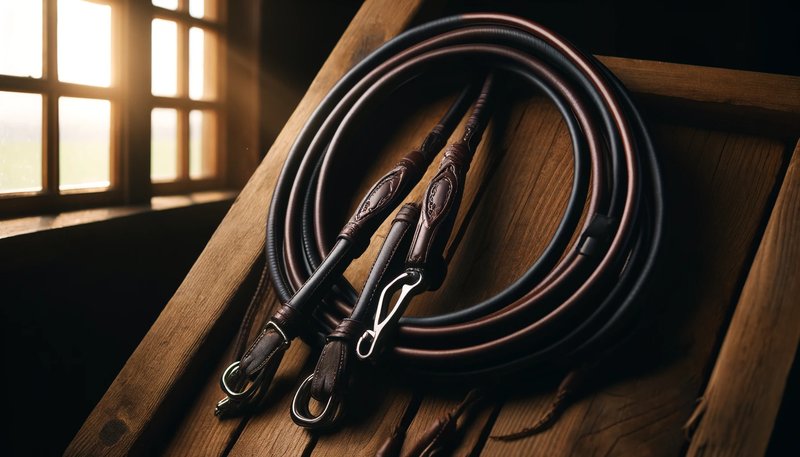
The Full-grain leather remains the standard for classical riding. It offers fine and progressive contact with the horse's mouth, making it ideal for dressage and higher education. With regular care, quality leather reins will last between 5 and 10 years. The leather develops a patina over time and becomes more supple.
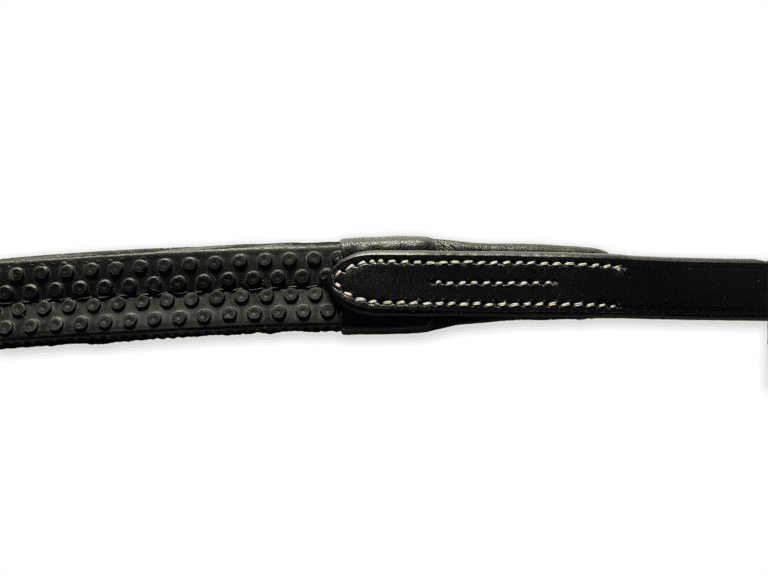
The main drawback: smooth leather slips in wet weather. This is why many riders opt for leather reins with grip inserts or some stoppers Seams that improve grip.
Rubber reins and grip
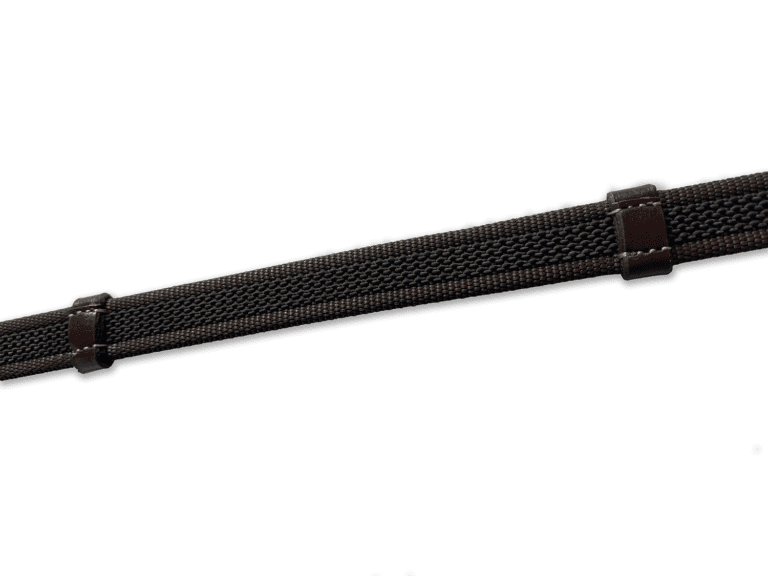
Grip reins (rubber or textured synthetic material) offer a maximum grip, even in the rain or with wet gloves. It is the preferred choice in Chief Security Officer and in Cross where the rider needs a secure contact when approaching obstacles.
They require less maintenance than leather, but their lifespan is shorter (3 to 5 years with regular use). The feel is also less subtle than with fine leather.
Mixed leather and rubber reins
The best of both worlds: the upper part in leather for elegance and comfort, the lower part (near the bit) in rubber for grip. It's a very popular compromise among riders Eventing who go from dressage to cross-country on the same day.
Good to know: In double bridle (advanced dressage), two pairs of reins of different widths are used. The bradoon rein is finer (12-13 mm) than the snaffle rein (15-16 mm) to distinguish them by touch.
Western reins and ethological reins
The Split reins (open reins) are the standard in Western riding. Wider (25-30 mm) and not joined together, they allow the horse to lower its head freely. In Ethology and groundwork, reins made of rope or biothane offer lightness and strength, with almost no maintenance.
What size of reins for your horse?
Overly long reins can trail and get caught. If they are too short, they create constant tension, which hinders the horse. Here are the standard dimensions:
| Size | Length | Withers height | Equid |
|---|---|---|---|
| Pony | 135-140 cm | Under 1.48m | Ponies A, B, C, D |
| Cob | 140-145 cm | 1.48-1.58 m | Small horses, cobs |
| Full | 145-150 cm | 1.58–1.70 m | Standard horses |
| XFull | 150-155 cm | Over 1.70m | Great horses, traces |
How to check the correct length In the saddle, with elbows bent at 90°, you must maintain a light and regular contact with the horse's mouth. There should be neither too much slack nor any excessive tension.
La width also influences comfort:
- Fine (12-16 mm) Double bridle, fine reins, dressage — subtle and precise contact
- Standard (18-20 mm) Versatile, suitable for the majority of riders
- Large (22-30 mm) western, endurance, large grips — comfort over long sessions
The breastplate: role, types and adjustment
The martingale prevents the saddle from slipping backwards during climbs, jumps or sudden accelerations. It is a piece of equipment security Above all, particularly useful for horses with a shallow or rounded wither.
3-point collar vs 5-point collar
| Criterion | 3-point collar | 5-point necklace |
|---|---|---|
| Fixation | 2 saddle attachments + 1 strap | 4 saddle attachments + 1 girth |
| Stability | Sufficient for everyday life | Maximum, optimal distribution |
| Best for | Hiking, rambling, leisure show jumping | Cross, intensive CSO, complete |
| Indicative price | 50-80 € | 80-120 € |
| Installation | Quick (2-3 mins) | Longer (4-5 min) |
There are also necklaces with integrated martingale which combine two functions in a single piece of equipment, practical for simplifying sealing. Some models feature elastic inserts which absorb shocks and offer greater shoulder freedom to the horse.
How to properly adjust a hunting collar
An improperly adjusted collar is useless, even dangerous. Follow these steps:
- Bridge position Place it about 10 cm in front of the withers, never on top.
- Progressive fixation first attach the side straps, then the belly strap
- 3-finger rule You must be able to fit three fingers flat between each strap and the horse's body
- Resting test When the horse lowers its head to the maximum, the saddle should not move backwards
- In-motion check at all three gaits, no visible friction or discomfort should appear
Good to know: The hunting collar is Compulsory on cross-country According to FFE regulations. In pure dressage, it is not permitted in competition. In show jumping, it is optional, but many professionals recommend it.
Choosing your reins and bridle according to the discipline
Each discipline imposes different constraints. Here are the recommended combinations:
| Discipline | Recommended reins | Hunting collar |
|---|---|---|
| Dressage | Fine leather 12-16 mm, precise contact | Not used in competition |
| Chief Security Officer | Rubber or mixed leather-grip grips | Recommended, especially with minimal bruising. |
| Cross / CCE | Reinforced non-slip grip | Compulsory (FFE regulation) |
| Endurance | Lightweight synthetic 16-20 mm | Recommended for hilly terrain |
| Western | Split leather reins 25-30 mm | Western collar specific |
| Hiking | Mixed leather-synthetic, hard-wearing | 3 points advised in the mountains |
The more intense the effort and the rougher the terrain, the more grip you'll need on your reins and security with a suitable hunting breastplate.
Maintaining your reins to make them last
Maintenance makes all the difference between leather that ages well and leather that cracks. Here are the correct habits:
Leather reins
- After every session Wipe away sweat and dirt with a damp cloth
- Every week : clean with glycerine soap (neutral pH) in circular movements
- Every month Feed with a leather balm suitable for saddles (no animal fats).
- Storage away from direct sunlight and humidity, on a ventilated surface
Rubber reins or synthetic reins
- After intensive use rinse with lukewarm water (30°C max)
- Regular inspection Check the condition of the seams and grip — if the rubber becomes hard or cracked, it's time to change
- Drying outdoors, never near a heat source
When to replace your reins?
Change your reins immediately if you observe:
- Deep cracks in the leather
- Frayed seams or loose threads
- Loops or karabiners showing play or oxidation
- A noticeable loss of grip on the reins.
SmartWag Tip: If you ride daily, alternating between two pairs of reins allows each pair to dry completely between uses, significantly extending their lifespan.
Common mistakes to avoid
Certains erreurs compromettent votre sécurité et celle de votre cheval :
- Reins too long The excess can trail and get caught under your foot if you fall. Check that the length is the correct size for your horse.
- Smooth leather in the rain If you regularly ride outdoors, invest in reins with a grip or wear suitable gloves.
- Forget the stops with a martingale : without stoppers, the martingale rings can get caught in the rein loops — a real risk of accident.
- Neglecting leather maintenance Dry, cracked leather loses its strength and can break suddenly.
- Shortening one's reins with a knot This creates a weak point and is forbidden in FFE competitions.
- Repairing seams yourself Amateur stitching drastically reduces strength. Entrust repairs to a professional upholsterer.
- Choke collar too tight excessive tightening hinders breathing and shoulder movement. Always follow the three-finger rule.
The SmartWag Reins: artisanal leather and custom engraving
At SmartWag, we have been working with full-grain leather for over 11 years. Our Fine reins fouled slip are designed to offer optimal grip while retaining the finesse of artisanal leather.
Each pair can be engraved personalised with your horse's name — a detail that makes all the difference in everyday life and at competitions. Engraving is complimentary on all our products.
Our reins pair perfectly with our Personalised leather bridles for a cohesive and elegant set. For riders who work without a bit, also discover our artisan sidepulls, ..., designed with the same attention to detail.
Delivery in 3 to 5 days to France, Switzerland and all of Europe.
Frequently asked questions about horse reins
What length of reins should I choose for my horse?
The length depends on the size of your horse: 135-140 cm for a pony, 145-150 cm for a standard horse (full) and 150-155 cm for a large horse (XFull). A good guide: elbows bent at 90°, you should maintain light contact without pulling or having too much slack.
What is the difference between a 3-point and 5-point tracking collar?
The 3-point breastplate has 2 attachments on the saddle and 1 on the girth. It is sufficient for hacking and everyday work. The 5-point breastplate adds 2 extra attachments to the saddle for maximum stability, recommended for intensive cross-country and show jumping.
Is a hunting collar mandatory in competitions?
It is compulsory in cross-country according to FFE regulations. In show jumping and dressage, it is not required but remains strongly recommended in show jumping for horses with a poorly defined withers. In pure dressage, it is generally not used.
Leather or rubber reins: which to choose?
Leather reins offer a fine feel and durability (5 to 10 years with proper care). Rubber or grip reins ensure better grip, especially in wet weather. For show jumping and cross-country, opt for grip. For dressage, leather remains the standard.
How to care for leather reins?
After each use, wipe away perspiration with a damp cloth. Once a week, clean with glycerine soap. Once a month, nourish the leather with a suitable balm. Store away from dampness and direct heat. Well-maintained leather lasts twice as long.
Conclusion
Choosing the right reins and martingale is an investment in comfortable communication with your horse and in your safety in the saddle. Adapt the material and size to your discipline, maintain your equipment regularly, and combine leather and grip if your practice requires it.
At SmartWag, we design every piece of full-grain leather with over 11 years of artisanal craftsmanship. Discover our customisable reins with free engraving, delivered in 3 to 5 days anywhere in Europe.